
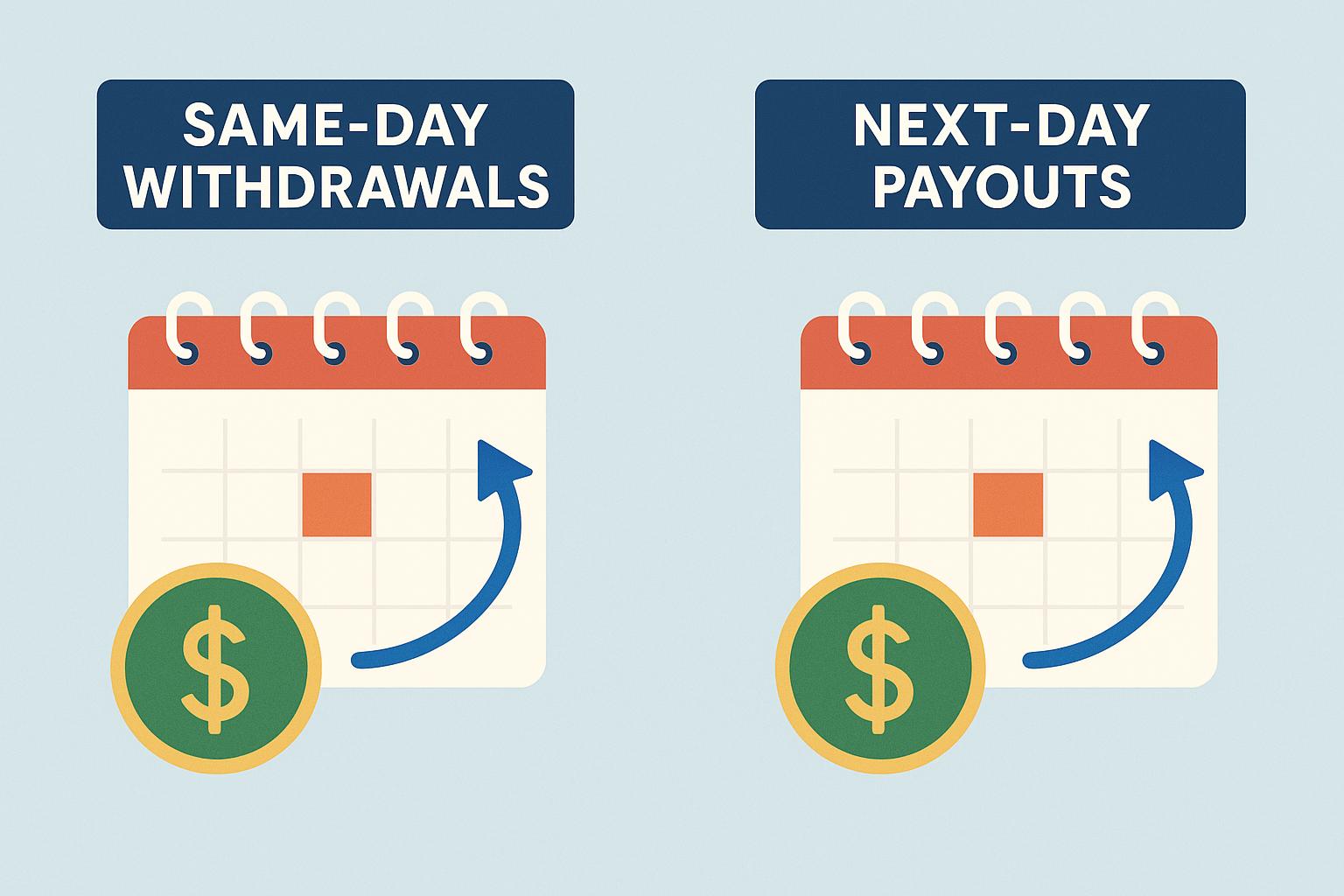
Understanding Same-Day Withdrawals
Same-day withdrawals are financial transactions where the funds are transferred and made accessible to the recipient on the very same day the transaction is initiated. This feature is particularly advantageous for those who require immediate access to funds for reasons such as emergency expenses or sudden investments. Financial institutions or payment processors typically offer this service at a premium, meaning it might involve higher fees compared to standard transactions.
How Same-Day Withdrawals Work
To facilitate a same-day withdrawal, several banking or processing entities utilize real-time payment networks or internal systems that can expedite the clearing and settlement process. In some cases, technological advancements allow users to process these transactions through online banking platforms or mobile applications, providing a secure and efficient means of accessing funds quickly. In practice, the mechanics of this system involve synchronization among financial agents to ensure the rapid transfer and reception of funds, prioritizing transactions that require an expedited timeline. Additionally, the institutions often employ dedicated teams to oversee and manage the expedited transactions to prevent any errors or delays that could inadvertently slow down the process.
Typically, using a same-day withdrawal service requires the user to log into their bank’s online portal or mobile app, where the option to initiate such a transaction is made available. The user can then specify the amount to be transferred and the recipient’s details, upon which the banking system handles the rest. Some service providers implement an additional layer of authentication, like two-factor verification, to minimize risks and ensure that only authorized transactions are processed with same-day speed. Thus, technology serves as a backbone, providing both security and agility in the contemporary financial landscape.
Exploring Next-Day Payouts
Next-day payouts, on the other hand, involve transactions where funds are processed and credited to the recipient’s account on the day following the initiation of the transaction. This method tends to be more cost-effective than same-day withdrawals, making it an attractive option for businesses and individuals who do not need immediate access to their funds.
The Process Behind Next-Day Payouts
Next-day payouts work by leveraging the overnight processing capabilities of banks and financial institutions. By batching these transactions, institutions can efficiently manage their resources while offering a convenient resolution timeline for their customers. Business entities, in particular, benefit from this feature as it helps in managing cash flow without incurring high fees. A typical workflow for a batch processing system involves collecting a day’s worth of transactional data and then processing it collectively during non-peak hours, often post-business hours. This efficiency of scale allows the institutions to handle larger volumes of transactions without the need to allocate significant additional resources, thereby reducing operational costs.
From the perspective of a business, opting for next-day payouts can provide a strategic advantage, allowing a balance between liquidity management and cost control. For instance, a small business managing payroll may find it favorable to use next-day transactions for regular payroll cycles, thus ensuring employees receive timely payments without the employer bearing excessive transaction costs. This approach helps in fostering better financial planning and budgeting, as predictable transaction costs and timelines are more manageable compared to the uncertainty that can arise with premium same-day services.
Comparing Same-Day Withdrawals and Next-Day Payouts
Cost Implications
While same-day withdrawals offer the benefit of immediate access to funds, they usually come at a higher cost due to the expedited processing required. Typically, financial entities may charge a premium in the form of transaction fees or percentage cuts of the amount being processed to compensate for the resources expended in fast-tracking these payments. In contrast, next-day payouts offer a balance of timely access to funds and lower transaction fees. By aligning with the standard processing cycles, these payouts keep costs diminished, benefiting those with less immediate financial demands.
Use Cases and Suitability
The choice between same-day withdrawals and next-day payouts largely depends on the user’s specific needs. Individuals or businesses requiring urgent liquidity might find same-day withdrawals indispensable. For example, a contractor who needs to purchase materials on time for a project can’t afford a delay and hence would be willing to bear higher fees for immediate fund availability. Alternatively, while planning for non-urgent payments, such as payments to suppliers for regular stock replenishment, attention to cost efficiency over speed might guide the decision in favor of next-day payouts, preserving financial resources.
Deciding between these services hinges on factors such as the urgency of the financial need, the amount being transacted, and the frequency with which such transactions occur. Frequent users of expedited services may opt for solutions like subscription models, where a flat fee is paid monthly for an unlimited number of transactions. On the other hand, occasional users might find it more pragmatic to pay per transaction, regardless of whether it’s a same-day or next-day service, based on immediacy versus thrift considerations.
Impact on Financial Planning
The differences in timing and cost implications of same-day withdrawals and next-day payouts have tangible effects on financial planning strategies both for individuals and businesses. For individuals, selecting the right method can affect monthly budgets and emergency funds’ allocation. By assessing when funds are needed, personal finance planners can better anticipate cash flow needs and cushion unnecessary expenses.
Businesses often have more complex financial needs, where choosing between these two services can dictate operational fluidity. For enterprises with tight profit margins, cost savings from preferring next-day payouts can amass into significant financial benefits over time. Conversely, for businesses where cash flow dictates operational feasibility, adopting faster withdrawal methods as part of a broader financial strategy may prove vital, enabling them to seize opportunities or mitigate disruptions smoothly.
Conclusion
In summary, the key difference between same-day withdrawals and next-day payouts lies in the timing of access to funds and associated costs. Both services offer unique advantages: the urgent immediacy of same-day withdrawals and the cost-effective reliability of next-day payouts. By understanding their specific financial needs and constraints, users can make informed decisions about which service best suits their requirements. As the financial sector continues to evolve with rapid technological advancements, the range of available options and the level of service customization will likely expand, empowering users with even greater choice and flexibility in managing their financial transactions efficiently.